
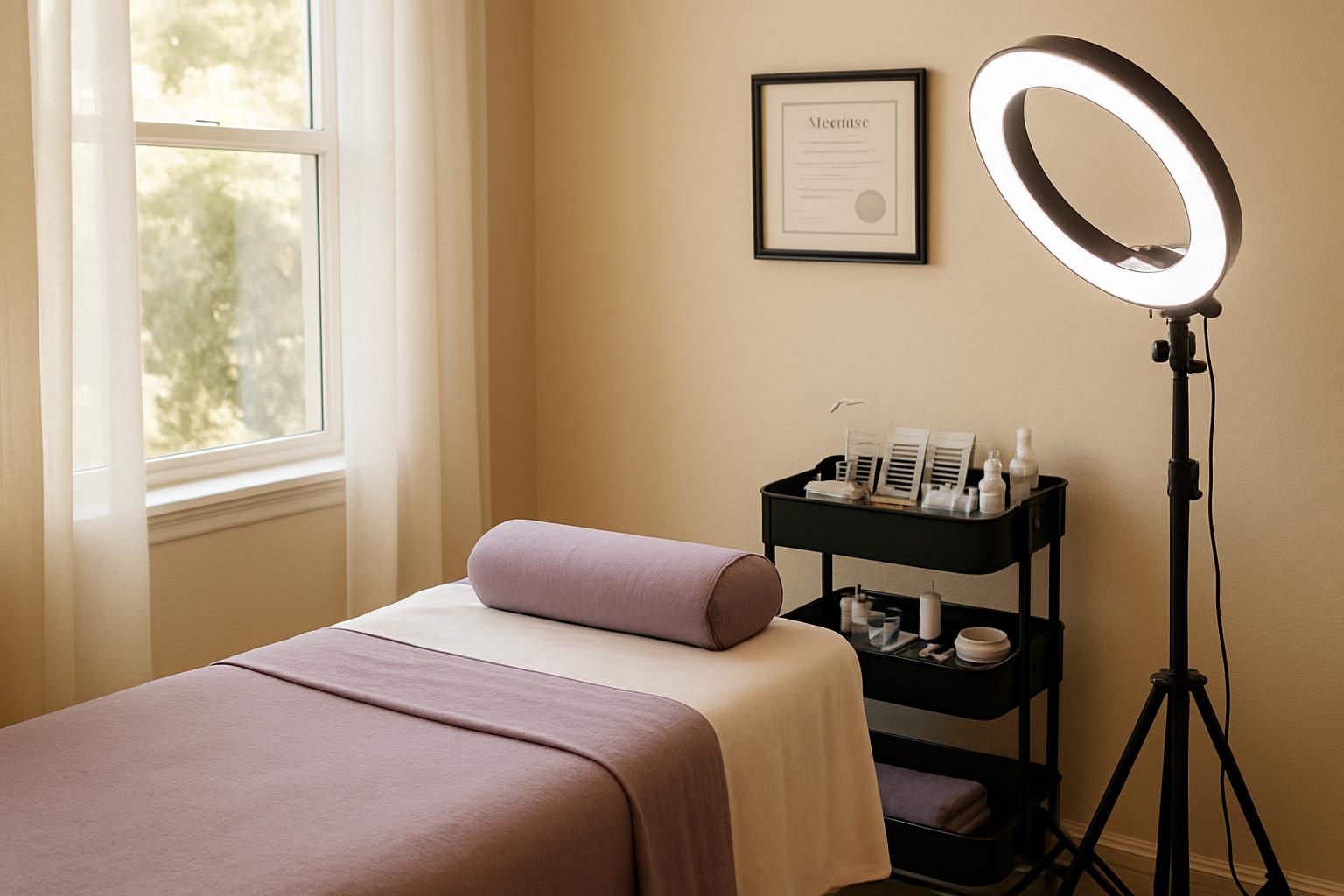
You’ve got your certificate, your lash bed, and a room you’re willing to turn into a workspace. You’re not ready for a salon suite. You’re not sure you’ll ever be. And you’ve spent time online watching other lash techs debate whether working from home is “professional” — the comment threads get nasty fast.
Here’s the thing: home-based lash businesses are real businesses. They operate in spare bedrooms and nurseries and converted garages all over the UK, Canada, Australia, and plenty of US states. The question isn’t whether it’s legitimate. The question is whether you’ve done it correctly — because “I work from home” and “I run a professional home studio” are two different things, and your clients can tell the difference.
This is the guide to getting it right.
Start Here: Know Your Local Rules
This is non-negotiable and it comes before everything else.
Licensing requirements for in-home esthetics services vary enormously by location. In the UK, many local councils allow home-based beauty services with basic registration and a premises inspection. In US states like California and Texas, there are strict rules about commercial activity in residential spaces, sanitation standards, and what constitutes a legal treatment room. Some municipalities require a business license for any home-based service business, period.
What to research before your first client:
- Your city/county zoning laws. Does your neighborhood allow commercial activity? Most residential zoning permits low-impact services (no signage, no employees, limited client traffic), but check explicitly.
- Your state/province cosmetology board rules. Can licensed estheticians legally work from a private residence? Several states have carve-outs; others don’t.
- Your rental or mortgage agreement. Running a business from a rented home may violate your lease. Read it. Some landlords are fine with it; others aren’t.
- Local health department requirements. Some jurisdictions require home treatment rooms to pass a sanitation inspection. This is more common for nail services and waxing, but it applies to lashes in some areas.
The research takes a few hours. The consequences of skipping it can cost you your lease or your license.
Insurance: This Is Not Optional
If you take one thing from this guide, make it this: you cannot operate without liability insurance, regardless of where you work.
General liability insurance covers you if a client claims an allergic reaction, eye injury, or damage from your services. Without it, you’re personally liable for any claim. Professional indemnity insurance covers you if a client claims your work caused them financial harm (loss of work due to an eye issue, for example).
In the UK, policies through providers like ABT or Guild start around £60–80/year. In the US, the National Association of Lash Artists (NALA) offers plans from around $109/year. For a business that charges $80–200 per service, this is not a meaningful expense.
What to get: general liability + professional indemnity. Some policies bundle both. If you use rented equipment or work in clients’ homes as well as your own, check whether that’s covered.
Get insured before your first paying client walks through the door.
The Room: Minimum Requirements
You don’t need a dedicated salon room. You do need a space that meets a few standards.
What actually matters:
- Sanitation. A hard floor (no carpet under your work area), cleanable surfaces, and a place to wash your hands or have sanitizer immediately accessible. You need to dispose of single-use materials properly — not in an open bedroom bin.
- Lighting. A lash artist working in inadequate light makes mistakes. A ring light or adjustable daylight lamp is not optional; it’s what allows you to see what you’re applying.
- Privacy. Your client is lying down for 1.5–2 hours with their eyes closed. They need to feel safe and not feel like they’re in someone’s living room. A dedicated space — even if it’s a sectioned corner — signals that you take this seriously.
- Temperature control. Lash adhesive is temperature and humidity sensitive (ideal: 20–25°C, 45–65% humidity). A room you can’t control means inconsistent retention, which means unhappy clients.
- A clear path in and out. Your client should be able to enter, receive a service, and leave without navigating your kitchen or kids’ toys. This is about experience, not aesthetics.
What doesn’t matter as much as you think:
- Salon-style decor. Clean and calm beats expensive.
- Dedicated entrance. If clients walk through your home, that’s fine — just make it feel intentional and professional.
- Square footage. A lash bed, your tools, good light, and a place to work: that’s all you need.
Client Communication Before the First Visit
This is where home-based businesses win or lose clients.
Many clients have never been to a home studio before. They don’t know what to expect. They might feel uncertain about their safety, about parking, about who they’re giving their phone number to. The way you communicate before their first visit determines whether they feel confident or anxious.
Do this for every new client:
- Send full arrival instructions. Specific address, parking notes, what entrance to use, whether to ring the bell or text when they arrive. Remove all guesswork.
- Tell them what they’re walking into. “I have a dedicated treatment room at the back of my home.” Simple, clear, no apology needed.
- Send your intake form before the appointment. A proper intake form surfaces allergy history and contraindications in advance, and it signals that you run a professional operation. A client who fills out a form before arriving has already made a mental shift — they’re a client at a professional service, not someone visiting a friend.
- Confirm 24 hours out. New clients especially benefit from a reminder that includes what to bring (no eye makeup, no contacts, arrive with clean lashes), what to expect, and your cancellation policy.
A new client who walks in knowing exactly where to go, what to expect, and what the rules are is a client who’s already relaxed before they lie down.
Pricing From a Home Studio
Working from home means lower overhead than a salon suite. That does not mean you should charge less.
Your training, your time, your insurance, your supplies, your equipment — none of that changed because you’re in your bedroom instead of a strip mall. The value you deliver to your client didn’t change either.
Price based on your market rate for your skill level. Use your location as a factor, not your workspace. A lash tech in a major metro working from home should charge roughly what a lash tech in a similar skill bracket charges from a shared suite.
If you’re worried about charging full price while you’re home-based, that worry is usually about confidence, not economics. Client trust is earned through consistent, quality work and professional communication — not a reception desk. Need clarity on what full price actually is for you? Work through the pricing formula.
Building Client Trust Without a Storefront
You don’t have a Google Business profile with 200 reviews. You don’t have a window sign. You’re building trust from scratch, and it takes longer without a physical storefront to anchor your legitimacy.
Here’s what actually works:
Your booking page. A professional online booking system — one that takes deposits, sends confirmations, and has a clean service menu — tells a new client more about your professionalism than your studio address does. The experience of booking matters.
Before and afters. Consistent photos, good lighting, real results. Post these. This is your portfolio. It’s more persuasive than any bio.
A clear cancellation policy. Post it publicly and enforce it. A tech who protects their time is a tech who takes their business seriously. Most clients respect this.
Referrals. Your best early clients are friends and people who already trust you personally. Ask for referrals explicitly. “If you liked your lashes, please send me a friend” is not pushy — it’s how small businesses grow.
Reviews. Ask satisfied clients to leave a Google review (even without a physical address, you can have a Google Business profile as a service-area business). These reviews live forever and drive organic bookings.
The Honest Part
Running from home has real tradeoffs. Your personal space is your workspace. Clients know where you live. It can be harder to establish separation between “work” and “not work” when they happen in the same room.
The solution isn’t to pretend those tradeoffs don’t exist. It’s to design around them: set business hours and stick to them, use a booking system so clients aren’t texting your personal number at 11pm, and have a clear sense of what type of space you eventually want to move toward. If you’re launching a home studio, follow the 30-day launch plan to get everything in place systematically.
Many successful lash techs started from home and moved to a suite when their books were full enough to justify the overhead. That’s the path, not a compromise. You build your client base first. The space follows.
LashDesk gives home-based lash techs everything they need to run a professional operation: online booking, deposit collection, client profiles, and appointment reminders — from wherever you work. Get started at lashdesk.com