
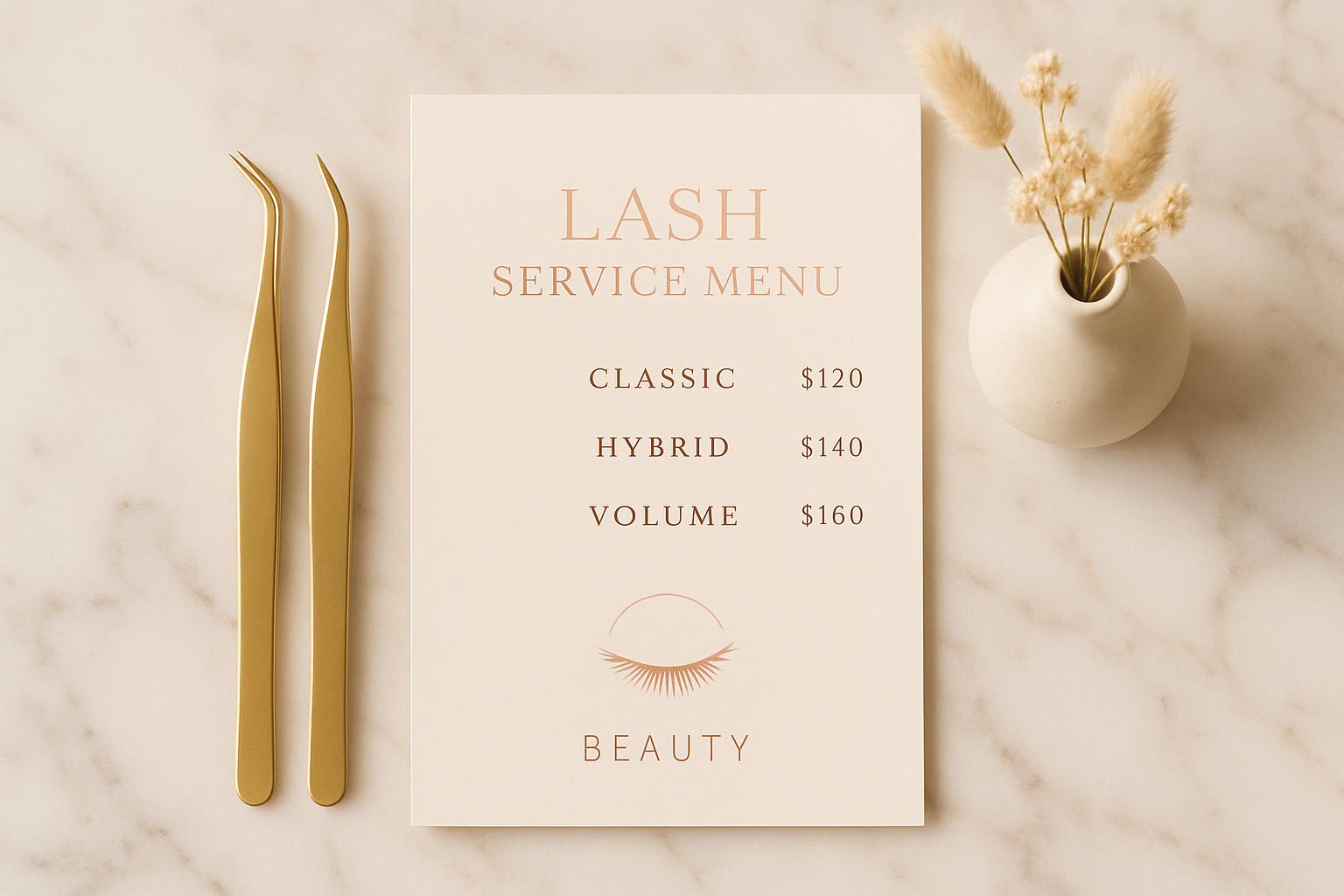
How to Build a Lash Service Menu That Sells
Most lash artists overthink their service menu. They list every possible style, length, curl, and technique, and end up with a page that reads like a restaurant novel no one wants to finish. Clients stare at it, get overwhelmed, and either book the cheapest option or don’t book at all.
A strong lash service menu does the opposite. It guides the client toward the right service quickly, removes decision fatigue, and makes your pricing easy to understand. If your lash extension menu isn’t converting browsers into bookings, the problem is almost always structure, not your skill.
Here’s how to build a lash services list that actually sells.
Why a Simpler Menu Sells Better
Every option you add to your menu is a decision your client has to make. And every decision is a chance for them to hesitate, second-guess, or leave.
Research on consumer behavior is consistent on this: fewer, clearer options lead to more purchases. This applies directly to your lash service menu. When a new client lands on your booking page, they should be able to identify the right service in under 30 seconds.
A simpler menu also:
- Reduces DMs and back-and-forth. If your menu is clear, clients stop asking “what’s the difference between X and Y?”
- Speeds up booking. Fewer choices means faster decisions.
- Positions you as an expert. You’re curating the experience, not dumping every option and hoping they figure it out.
The goal is not to list everything you can do. It’s to list what your clients actually need to choose from.
The 3 Anchor Sets: Classic, Hybrid, Volume
Your lash extension menu should be built around three core full sets. These are your anchors: the foundation everything else hangs on.
Classic Full Set
One extension per natural lash. This is your entry-level service and often your most-booked set for first-time clients. It delivers a natural, mascara-like look without heavy density.
Hybrid Full Set
A mix of classic single lashes and handmade volume fans. This sits in the middle of your menu in both density and price. It’s the sweet spot for clients who want more than classic but aren’t ready for a full volume look.
Volume Full Set
Multiple lightweight extensions fanned onto each natural lash. This is your premium core service: fuller, more dramatic, and priced accordingly.
That’s it. Three full sets. Each one has a clear visual difference, a distinct price point, and a logical step up from the one before. If you haven’t nailed your pricing for each tier yet, our pricing formula guide walks through the exact math. Clients can self-select based on the look they want without needing a consultation just to understand your menu.
If you specialize in a technique like wet-look or anime lashes, you can add that as a fourth option. But resist the urge to list five or six variations of volume sets with slightly different fan counts. Your clients don’t think in fan ratios. They think in looks.
Pairing Fills with Full Sets and Clear Durations
Every full set on your menu needs a corresponding fill service. This is where a lot of lash service menus get messy. Artists list fills without specifying which set they apply to, or they create a confusing grid of fill options based on how many weeks it’s been.
Keep it straightforward:
- Classic Fill: 60 minutes
- Hybrid Fill: 75 minutes
- Volume Fill: 90 minutes
Each fill is tied to its parent set. Each one has a fixed duration. Clients know exactly what they’re booking and how long it takes.
Set a retention window for fills, typically 2 to 3 weeks from the last appointment. If a client shows up past that window with significant lash loss, they need a full set, not a fill. Make this policy visible on your booking page so there are no surprises. For the full breakdown on policies that protect your time, see booking policies that reduce no-shows.
If your fill rules depend on the set a client booked, connect the menu to the rest of the booking flow. The lash booking setup checklist helps you line up services, deposits, intake, prep, aftercare, and rebooking, while the policy generator turns the fill window and appointment boundary into wording clients see before they pick a time.
You can also offer an Extended Fill option for clients who fall just outside the window (say, 3 to 4 weeks) at a higher price and longer appointment time. This captures revenue you’d otherwise lose from clients who can’t always rebook on schedule.
Add-Ons vs. Custom Quoting
Add-ons are the extras that don’t warrant their own full menu category but still bring in revenue. List them separately from your core sets so they feel optional, not required.
Good add-ons for a lash services list:
- Colored lash extensions: a flat upcharge on top of any set or fill
- Bottom lash extensions: priced as a standalone add-on
- Lash removal: listed with a fixed price and duration
- Lash bath / aftercare treatment: quick service, easy upsell at checkout
The key is to give each add-on a fixed price. Avoid language like “starting at” or “price varies” wherever possible. Variable pricing creates friction. If a service truly requires custom quoting, like a full creative set with multiple colors and placements, label it as a consultation-required service and keep it separate from the main menu.
The majority of your bookings should be completable without a DM, a phone call, or a quote request. If clients have to message you before they can book, you’ll lose a percentage of them every single time.
One Premium Option for Upselling
Beyond your three anchor sets, consider offering one clearly premium service. This serves two purposes: it captures clients willing to pay more, and it makes your standard volume set look more reasonably priced by comparison.
Good candidates for a premium tier:
- Wispy Set: textured, Pinterest-style mapping with staggered lengths
- Mega Volume Set: ultra-dense fans (6D-16D) for a dramatic, full look
Pick one. Give it a name, a price that reflects the extra time and skill, and a clear description of what makes it different from your volume set. Don’t add three premium tiers, because that defeats the purpose. One premium option creates an aspirational anchor at the top of your menu without cluttering it.
This also gives you a natural upsell path. When a volume client mentions wanting “more fullness” or a “fluffier look,” you have a named service to recommend instead of trying to upsell vaguely.
Monthly Menu Audits: Cut What Doesn’t Sell
Your lash service menu isn’t a set-it-and-forget-it page. Review it monthly using actual booking data.
Ask yourself:
- Which services haven’t been booked in 30 days? If nobody is booking a service, it’s adding clutter without adding revenue. Remove it or fold it into an existing category.
- Which services have the lowest margins? Time is your most limited resource. If a service takes 2.5 hours but you’re charging the same as a 90-minute set, the math doesn’t work. Reprice it or drop it.
- Are clients frequently asking for something you don’t list? That’s a signal to add it, but only if you can price it profitably and deliver it consistently.
- Are add-ons actually getting selected? If an add-on has a near-zero attach rate, it’s dead weight on the menu. Either promote it better or remove it.
A monthly audit takes 15 minutes. Open your booking data, look at what’s moving, and trim what isn’t. A lean menu outperforms a bloated one every time.
Action Steps
- Reduce your full sets to three: Classic, Hybrid, and Volume. Add one premium option if it fits your brand.
- Create a matching fill for each full set with a fixed duration and a clear retention window policy.
- List add-ons separately with fixed prices. Move anything that requires custom quoting into a consultation-required category.
- Set your premium tier. Pick one aspirational service and price it above your volume set.
- Schedule a monthly menu audit. Block 15 minutes on your calendar to review booking data and cut underperformers.
- Put your menu where clients actually see it. Your booking page, your Instagram link-in-bio, and your website should all point to the same, current version of your menu. If you’re launching fresh, our 30-day launch plan covers when to finalize your menu in the context of everything else you need to set up.
Build Your Menu on a Platform That Supports It
A well-structured lash service menu only works if your booking system can display it cleanly and let clients book without friction. LashDesk is built specifically for independent lash artists, with your services, your schedule, your brand, and online booking that makes your menu easy to navigate.
If you’re starting from scratch or reworking your current setup, use the LashDesk Starter Kit for templates and checklists to build your service menu, set your pricing, and launch your booking page.
Try the Service Menu Builder
Put this into practice right now. The service menu builder walks you through everything covered in this post with no sign-up required.
Get the Full Starter Kit
All seven tools plus pricing formulas, policy templates, client scripts, and a 30-day launch plan, delivered to your inbox as one download.