
You’ve spent twenty minutes on Reddit asking strangers what lashes to get. You’ve saved fourteen screenshots of styles you love. You’ve typed “hooded eyes lash extensions” into Google twice. And then you walk into your appointment and say, “just something natural, you decide.”
This is the most common conversation in the lash industry. If you’re getting extensions for the first time, start with the full first-time guide — this breakdown of eye shapes is one piece of the bigger picture. Clients arrive with no vocabulary, no reference points, and a vague idea of what they want. The result: extensions that don’t match the inspo photos, a tech who guessed wrong, and a client too polite to say so until they’re home.
Lash style isn’t subjective magic. There are actual rules — about what flatters each eye shape, what creates lift, what adds width, what weighs things down. Once you know them, you can walk into any appointment and describe exactly what you want. And if you’re a lash tech, you can stop starting from scratch every time a client hands you a photo of someone with completely different eye geometry.
Let’s go through each shape.
First: Identify Your Eye Shape
Before anything else, figure out your starting point. Look in a mirror straight on, relaxed face, natural light. You’re looking for:
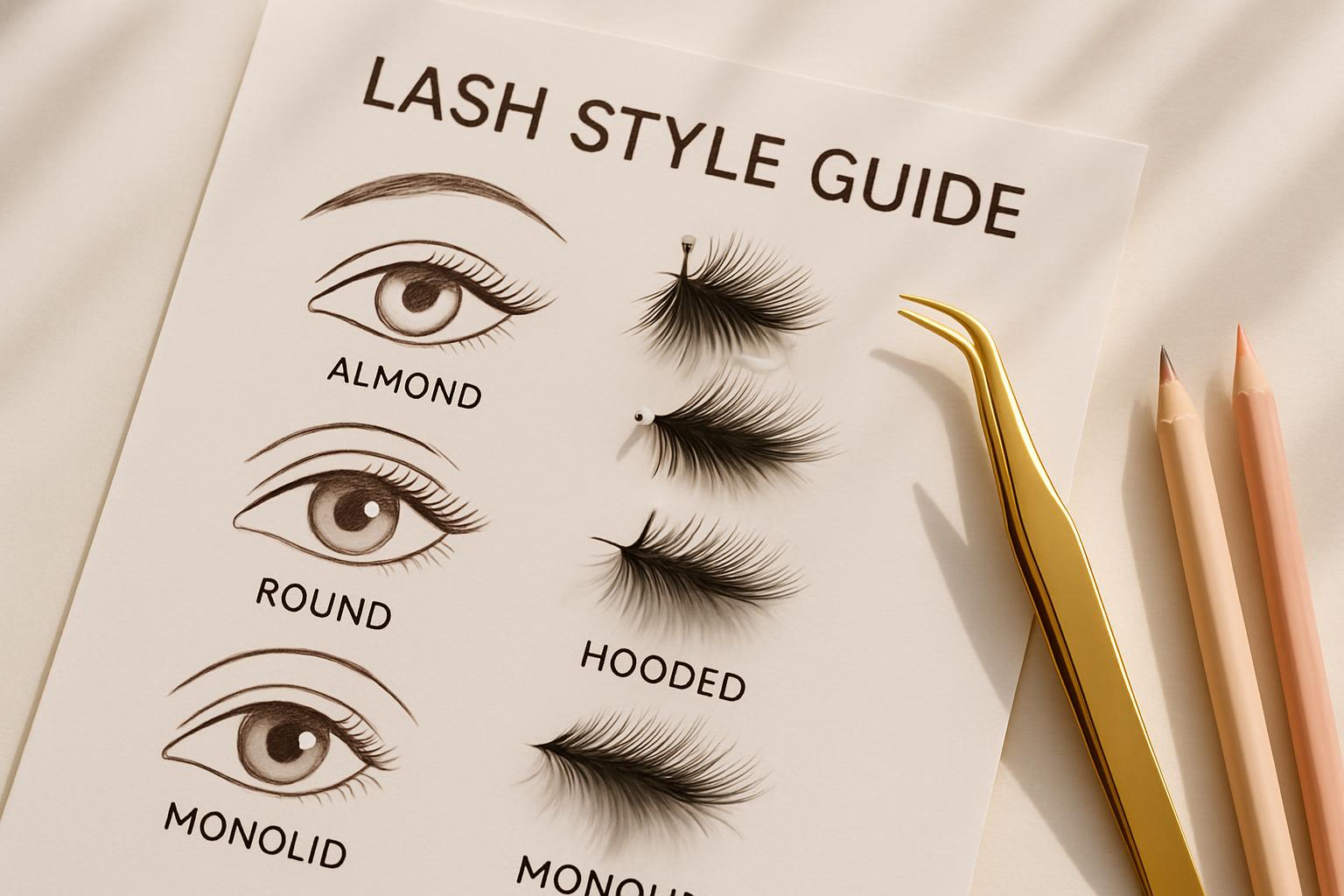
- Almond: Classic oval shape, slightly tapered at both corners, visible white on both sides. The most common and versatile shape.
- Round: Full and circular, roughly equal height and width, lots of visible iris. Eyes appear large and open.
- Hooded: A fold of skin sits over the crease, making the lid less visible when open. Can look smaller than it actually is.
- Monolid: Little to no visible crease. Flat lid appearance. Common in East Asian eye shapes.
- Downturned: Outer corners angle slightly downward. Eyes have a naturally drooping appearance at the edges.
- Upturned: Outer corners angle upward. A natural cat-eye lift.
- Wide-set: More space between eyes than average (more than one eye-width apart).
- Close-set: Less space between eyes than average.
Most people have a combination — pick the most dominant characteristic. That’s your starting point.
Almond Eyes: Almost Anything Works
Almond eyes are the most forgiving shape. The natural elongation and proportional balance means you can wear most styles without anything looking off.
That said, “almost anything works” doesn’t mean every choice is equal.
The best result comes from cat-eye or textured wispy mapping — this brings out the natural elongation and adds a slight flick that suits the shape. A cat-eye map means shorter inner corners, longest extensions at or near the outer corners, then tapering off at the very edge.
Glamour volume looks excellent on almond eyes but is heavier to maintain. If you want something low-effort between fills, opt for light hybrid (2D–3D) over full volume.
Ask for: cat-eye or doll-eye mapping, C or CC curl, lengths ranging from 9–13mm. Light hybrid for everyday; 4D–8D volume for events.
Avoid: Nothing’s truly off-limits, but mega volume on a daily basis is more maintenance than most people realize.
Round Eyes: Add Length, Not Width
Round eyes are already open and expressive. The instinct is to “open them up more” — but that’s backwards. What you actually want is length.
A cat-eye map does this well. Longer extensions at the outer corners pull the eye horizontal, creating an elongated, slightly sultry look that counteracts the roundness without making eyes appear smaller.
What doesn’t work: doll-eye mapping, which concentrates the longest extensions at the center. That emphasizes the roundness rather than balancing it.
Ask for: cat-eye or squirrel mapping, extensions notably longer at the outer corners (12–14mm), D or L curl for drama without excessive lift. Inner corners stay shorter (8–9mm).
Avoid: Doll-eye or round mapping, equal-length sets, anything that emphasizes vertical height over horizontal length.
Hooded Eyes: Curl Is Everything
This is where most advice goes wrong. For hooded eyes, the problem isn’t length — it’s visibility. An extension that looks bold on a flat lid disappears when a skin fold closes over it. Going longer doesn’t solve the problem. The right curl does.
Use a strong curl: L, M, or L+ curl. These start curling more dramatically from the base, keeping extensions visible above the fold even when the eye is open and in motion. A standard C or B curl will tuck right under the hood.
For mapping, doll-eye or squirrel (longest in the center-to-outer third) adds the illusion of lift. Avoid very long outer-corner extensions if your fold tends to pull them downward — on hooded eyes, outer length can drag rather than lift.
Length: 10–12mm maximum. Going longer creates bend and weight that fights the curl. Moderate length with a strong curl outperforms long extensions with a weak one every time.
Ask for: L or M curl, 10–12mm, doll-eye or squirrel mapping, classic to light volume. Tell your tech you have a hood — ask them to check visibility with your eyes open before you leave.
Avoid: B or C curl, very long extensions (13mm+), outer-heavy cat-eye mapping.
Monolid Eyes: Make the Lash Line the Feature
Monolid eyes have no visible crease, which means the lash line is the definition point. Extensions create dimension that eyeliner alone can’t sustain through the day.
The goal is visible curl — something that lifts away from the flat lid surface and stays visible. L, M, or D+ curl works well here for the same reasons as hooded eyes.
Open-eye or doll-eye mapping (longest extensions in the center) creates the appearance of depth and opens the eye. Wispy texture adds dimension without heaviness.
Keep volume light — classic to 3D. Heavier volume can overwhelm the lid and lose definition. Let the curl and placement do the work.
Ask for: M, L, or D+ curl, 9–12mm, doll-eye mapping, classic to light hybrid. Ask about mixed curl to add dimension through the set.
Avoid: B curl, outer-only mapping, high-volume (6D+) that overwhelms the lid.
Downturned Eyes: Counteract the Angle
Downturned eyes have outer corners that angle down — beautiful, but the wrong mapping amplifies the droop instead of lifting it.
The fix is a modified cat-eye map where the longest extensions sit at the three-quarter point, not at the very outer corner. Standard cat-eye places the peak length at 90% of the lid. For downturned eyes, move that peak to about 75% — this creates an upward angle before the natural droop begins.
Think of it as lifting the midpoint of the eye rather than the tail.
CC or D curl helps here too. You want the extensions themselves arcing upward, not just angling outward.
Ask for: squirrel or modified cat-eye mapping (peak at 75%), CC or D curl, mid-length overall (10–12mm). Be explicit with your tech — tell them your corners turn down.
Avoid: Standard cat-eye with full outer length, B or C curl, anything that adds weight to the outer edge.
Upturned Eyes: Balance the Natural Lift
Upturned eyes already have the cat-eye effect built in. Going full cat-eye mapping can push the look into something sharp or severe.
The best choice is doll-eye or natural mapping — longest extensions in the center, evenly distributed length toward both corners. This rounds out the natural upward angle and creates balance.
B or C curl works well. Avoid D+ or L curl, which adds upward lift to something that already has lift.
Ask for: natural or doll-eye mapping, B or C curl, balanced lengths. Nothing dramatically longer at the outer corners.
Avoid: Cat-eye mapping, dramatic outer extensions, D+ curl.
Wide-Set Eyes: Bring the Focus Inward
Wide-set eyes have more space between them than average. Extensions can help by adding visual weight toward the inner corners.
Use inner-corner-forward mapping — a few longer or wispy extensions on the inner third draw attention toward the center. You don’t need dramatic inner corner spikes; even 7–8mm inner extensions with some texture create that pull.
Avoid extra-long outer-corner extensions that spread focus further apart.
Ask for: inner corner definition (short wispy spikes work well), natural or balanced mapping, lengths that taper more toward the outer edge than they build.
Avoid: Outer-heavy cat-eye, very long outer extensions, mapping that adds horizontal span.
Close-Set Eyes: Extend Outward
Close-set eyes benefit from the opposite approach. Longer, more dramatic outer extensions pull focus outward and create visual separation.
Cat-eye or extended mapping does this well. Keep inner corners short — nothing that adds weight toward the bridge.
Ask for: cat-eye mapping, shorter inner corners (8mm), longer outer extensions (12–14mm), D curl for extra edge drama.
Avoid: Inner corner length, doll-eye mapping, equal-length sets.
What to Tell Your Tech (The Four Things)
No matter your eye shape, show up ready to give your tech these four pieces of information:
1. Your eye shape. Even “I think I have hooded eyes but I’m not sure” is more useful than nothing.
2. A reference photo. Saved to your phone — even a strip lash photo counts. If you wore a set of Ardell Wispies and loved them, say that. It’s a real data point your tech can work from.
3. Your lifestyle. Do you sweat, swim, or wear glasses? Do you do your own fills or come in every 3 weeks like clockwork? This affects what length and curl actually holds for you.
4. Your maintenance threshold. If you’re willing to come in every 2–3 weeks, you can carry heavier volume. If you prefer longer intervals, a lighter set that grows out gracefully serves you better.
That’s it. Your tech can do the rest.
A Quick Reference
| Eye shape | Best mapping | Best curl | What to avoid |
|---|---|---|---|
| Almond | Cat-eye or doll-eye | C/CC | Nothing — most things work |
| Round | Cat-eye or squirrel | D/L | Doll-eye, center-heavy mapping |
| Hooded | Doll-eye or squirrel | L/M/L+ | B/C curl, outer-heavy mapping |
| Monolid | Open-eye or doll-eye | M/L/D+ | Low curl, high volume |
| Downturned | Modified cat-eye (75%) | CC/D | Full outer-corner length |
| Upturned | Natural or doll-eye | B/C | Cat-eye, D+ curl |
| Wide-set | Inner-corner-forward | C/CC | Long outer extensions |
| Close-set | Cat-eye or extended | D | Inner corner length |
One more thing: if you had a great set at a previous appointment, take a photo before your next fill. That photo is worth more than any style name.
LashDesk helps lash artists track what works for each client — lash maps, preference notes, and visit history — so every fill starts from a known good place. See how it works.